The story of eyeglasses began with a simple yet revolutionary idea — placing two small lenses in front of the eyes. From that moment, the world became clearer, and people gained new opportunities to learn, read, and work.
Later, eyeglasses transformed into one of the standout accessories on the world’s top fashion runways.
20.11.2025
THE EVOLUTION OF EYEGLASSES: From Practical Tool to Style Icon
THE SECRET OF THE CONVEX LENS
Long before the invention of eyeglasses, humans were already trying to understand the mysteries of light and vision.
The Roman philosopher Seneca the Younger (4 BCE – 65 CE) noticed that a glass sphere filled with water could magnify text — a discovery echoed in earlier experiments in Greece. It was the first step toward the joy of seeing the world in clarity.
But several more centuries had to pass before artisans in the narrow streets of Pisa and Venice created the first recognizable eyeglasses in the 13th century: two simple convex lenses joined together and balanced on the nose. No style, no luxury — just a necessary tool for monks and scholars who spent hours hunched over manuscripts.
Scientific progress later brought concave lenses for the nearsighted and convex lenses for the farsighted. These innovations allowed thousands of people to reclaim the clarity of their vision. Eyeglasses gradually came to be seen not only as a tool, but also as a symbol of intellect and elevated social status.
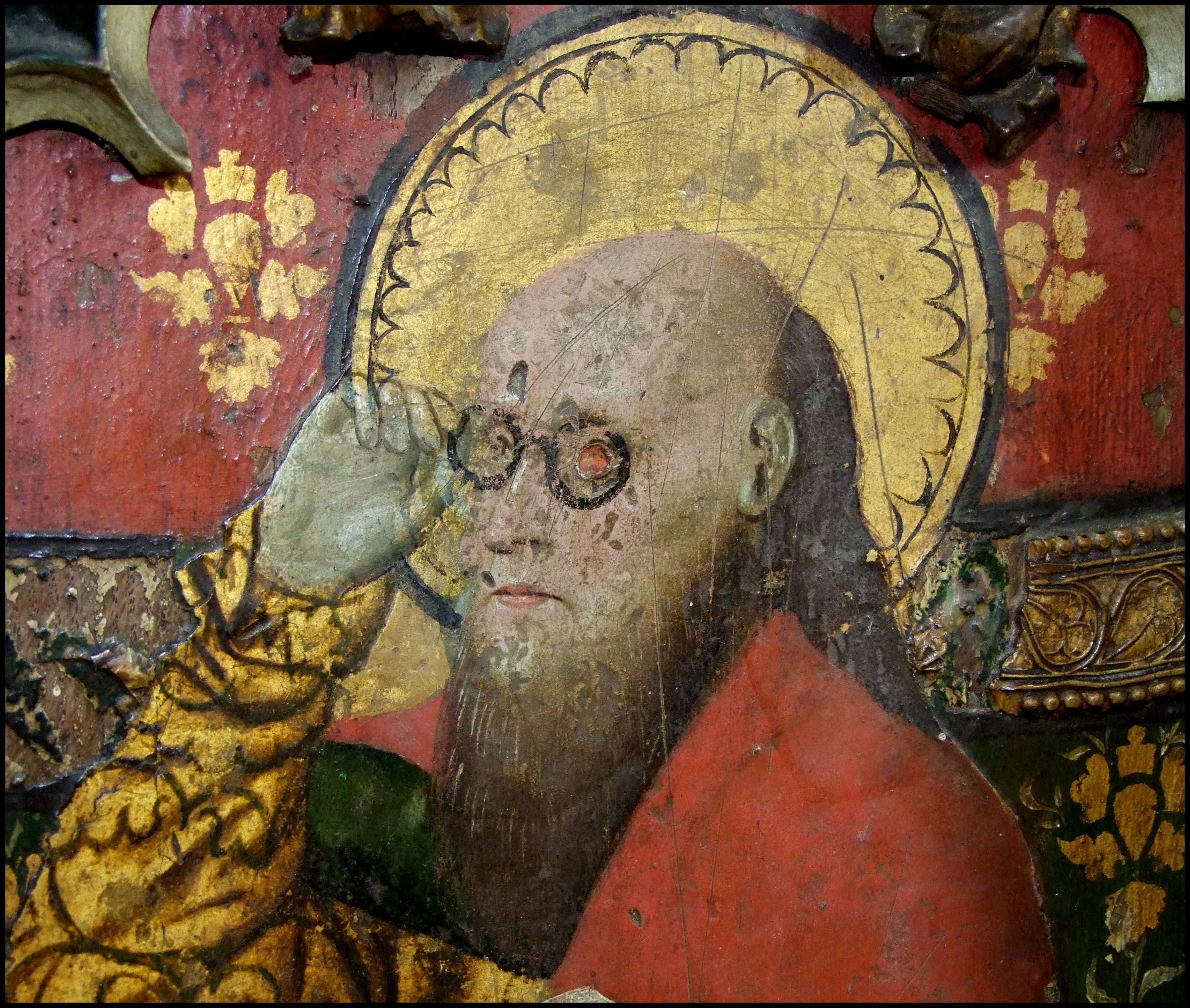
Art responded too. In Tommaso da Modena’s 1352 fresco, a monk reading with eyeglasses appeared for the first time in the history of art. From that moment on, spectacles became an emblem of wisdom and knowledge.
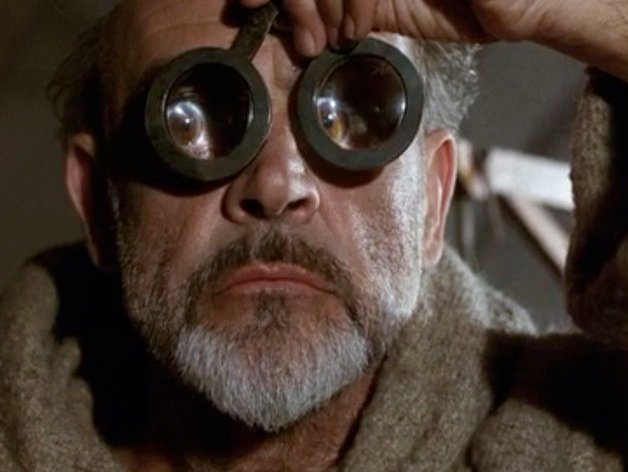
Umberto Eco’s The Name of the Rose, set in 14th-century Italy, echoes this symbolism. One of the main characters, William of Baskerville, astonishes everyone with his eyeglasses — a sign of his intellect and belief in progress. In the 1986 film adaptation, William was portrayed by Sean Connery.
THE RENAISSANCE ERA: The Rise of Eyeglasses
Between the 14th and 17th centuries, eyeglasses evolved both in form and in meaning. Early frames were crafted from wood, bone, or leather and had no temples — they had to be held by hand or balanced on the nose. Innovators of the period introduced “jointed” spectacles, a brilliant solution that allowed the arms to fold, making them significantly more comfortable to wear and far easier to store.

THE INDUSTRIAL ERA: A New Opportunity
In the 18th century, one of the Founding Fathers of the United States — the great inventor Benjamin Franklin — created the first bifocal lens while switching between two different pairs of spectacles. His invention laid the foundation for today’s modern multifocal glasses.
During the Industrial Revolution, lens production became far more precise: grinding machines ensured perfect shapes, while metal wire frames, standardized lenses, and adjustable nose pads made eyeglasses widely accessible.
No longer a privilege of the upper class, glasses became an essential tool for a large part of society.

THE ERA OF SUNGLASSES
The early 20th century saw the birth of the modern sunglasses. Although tinted lenses had long been used in medicine, in 1929 Sam Foster introduced them to the mass market — marking the beginning of an entire fashion industry.
During World War II, the U.S. Army Air Forces commissioned special anti-glare eyewear. The solution created by Bausch & Lomb — the now-iconic Ray-Ban Aviator — soon left the cockpits and became an eternal symbol of style.

WHEN DESIGN TOOK OVER THE WORLD
In the second half of the 20th century, eyewear changed radically: it stopped being merely practical and became a form of self-expression. Designers and brands began experimenting with colors, shapes, and materials.
The Oliver Goldsmith “Manhattan” sunglasses worn by Audrey Hepburn in Breakfast at Tiffany’s forever linked eyewear with elegance and luxury.
Elton John’s bold and eccentric glasses became a defining part of his stage persona.
John Lennon’s round frames remained his signature look for decades. And even though Kanye West’s shutter shades were far from comfortable, they sparked a new wave in pop culture.

TECHNOLOGICAL INNOVATIONS
In the 21st century, the world of lenses introduced blue-light–filtering coatings, anti-fog treatments, adaptive “transition” technologies, and ultra-thin, lightweight materials.
And frames — once limited mostly to plastic and metal — are now crafted from a wide variety of materials, including recycled plastics.
Eyewear has also taken on a new role: it has become both smarter and more sustainable.
“Smart glasses” such as Google Glass, Ray-Ban Stories, and soon Apple Vision Pro, offer a world where information becomes accessible directly through the frame of your glasses.

THE ARMENIAN FOOTPRINT IN THE WORLD OF EYEWEAR
On the vast map of eyewear history, Armenians have left their mark as well.
In the diaspora, French-Armenian designer Alain Mikli made a lasting impact with a brand that became a global fashion symbol. His name became associated not only with distinctive design, but also with the idea of eyewear as a means of self-expression.
And in Armenia’s market, Danz is writing its own story. The brand is shaping a local aesthetic while simultaneously opening new doors for Armenian design.